SONIC FLOTSAM
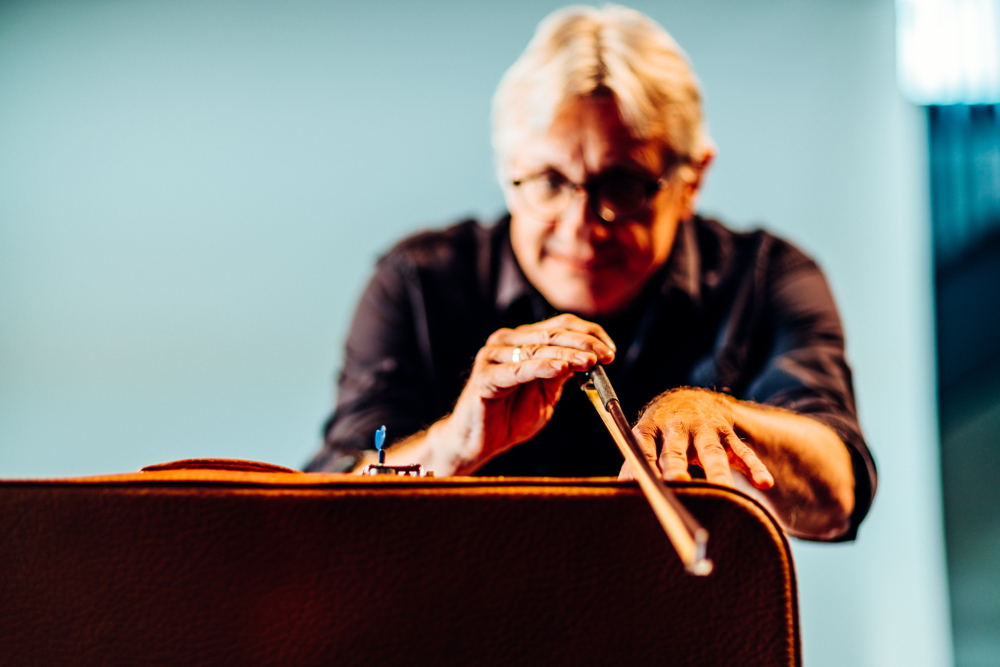
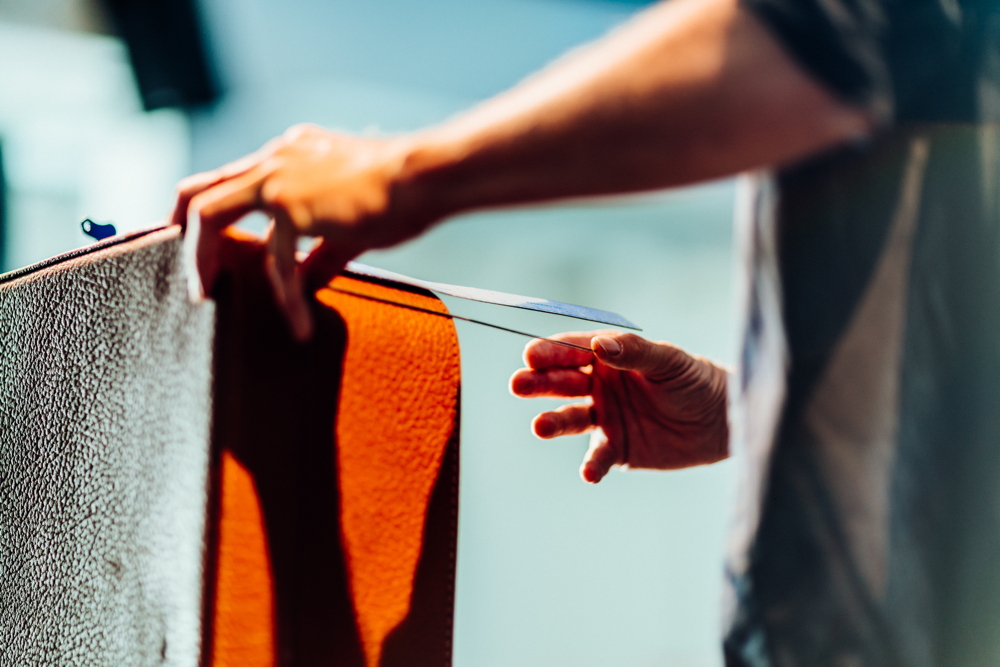
Sonic Flotsam uses found objects - found in the cities I perform in - as instruments. Old wooden and leather suitcases, especially decrepit ones, have been shown to be excellent resonant objects, and they are of special interest to me as they conjure up images of travel, exile & displacement.
I am indebted to Pauline Oliveros’ Apple Box approach, where objects act as filters and amplifiers for the sounds coaxed from their resonant bodies through contact microphones. Sonic Flotsam is an alternative to the use of (disembodied) field recordings when relating to a specific location, the project does not take sounds out of their context. By exploring the suitcase's sonic properties I am imagining (this is the absurdist part) what it would say to us if it could talk. Each suitcase is different, as it has to come from the city I am performing in. Each performance is unique und unpredictable, depending on the materials the suitcase is made of, and the state it is in. Of course, the room plays a role in it, too, each performance is site-specific by design.
I started programming my interactive software in the year 2000. Today, it creates internally eight independent voices from any source, voices that are then electronically altered, processed and spatialized. This allows the object to speak to its environment. Ambisonics is then used to travel those eight voices through any stereo or multichannel system imaginable. This approach connects directly to the displacement embodied in the suitcase: as the center of the sound environment moves, the listeners themselves are displaced and moved in & out of the space.
Sonic Flotsam 2025 is an update on the original 2018 project that was using small handheld fans. As part of a Harvestworks Artist in Residency grant, Harvestworks engineer Noor Sabreen built an arduino-based motor system that allows me to control five high-speed motors in realtime. The piece has been performed on stereo sound systems, styrofoam plates using transducers, and on multichannel systems up to 320 speakers.
Sonic Flotsam 2025 w/ Arduino-controlled Motors
A note on the speaker system at MH Lübeck (first video below): The system at that University consists of two arrays, a three-dimensional one (i.e. using height speakers) using 32 speakers, and 288 speakers surrounding the audience generally used for Wavefield Synthesis. My software generally creates eight independent processing voices, and arranges them internally as a virtual cube, i.e. four speakers on the "ceiling" and four speakers on the "floor" (starting from that, the eight voices will move independently through the virtual space). Ambisonics is used to project those eight voices onto any speaker configuration imaginable, using spat~ inside Max/MSP.
But what to do with the 288 speakers from the Wavefield Synthesis System? These are arranged on a plane surrounding the audience, roughly at the height of their ears. Using the same ambisonics technology would only position the sounds at the same locations the 32-speaker system provided, as some of their speakers are also located at the audience's ear height. I am greatly indebted to Kristin Kuldkepp, the department's sound engineer, who came up with a solution that sounded by far the best: as the room was a large rectangle, she divided the rectangle into two sections. Sending her the original eight voices from the virtual "cube", she situated the four "ceiling" speakers in the front of the space, and the four "floor" speakers in the back. One could walk around in the space for the most spatialized listening experience.
For the second video (from a performance at SVA), the “speaker system” consists of large styrofoam plates, the sound is transmitted to them using transducers.
Sonic Flotsam w/ Handheld Fans


Suitcase Examples

Berlin 2026
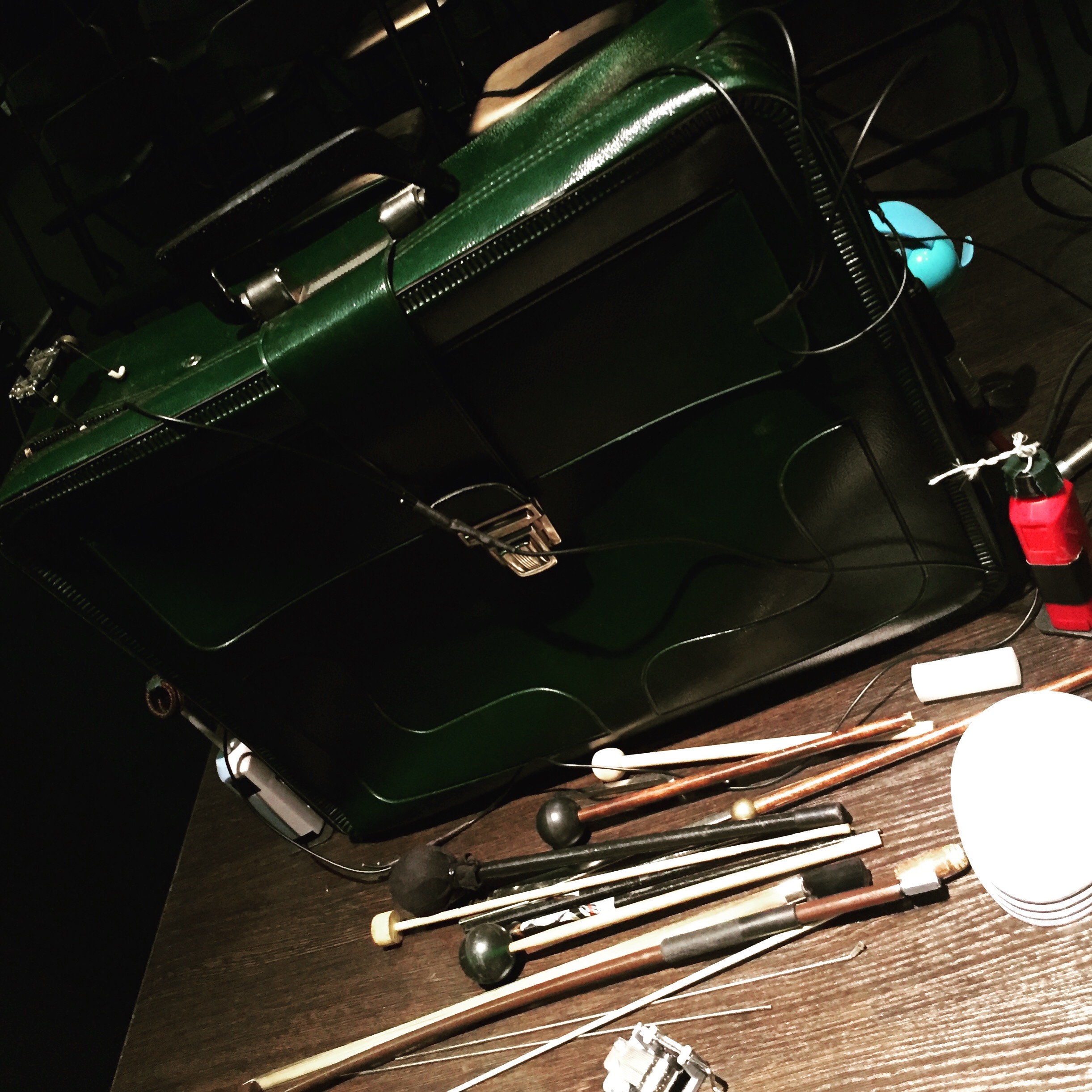
St. Petersburg, Russia 2019

Frankfurt 2026

Cologne 2023

Moscow, Russia 2019

Kassel, Germany 2026

New York 2024

Kassel, Germany 2023

New York 2020

Lübeck, Germany 2026

Sound Symposium, St. John’s, Newfoundland 2026
Hamburg 2018 (First) Performance
all photos Gerhard Kühne